
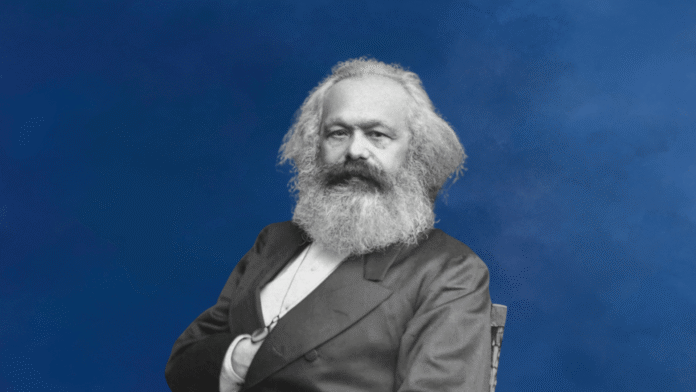
In the world of politics and economics, Karl Marx’s Capital is one of the most quoted works. Yet it is often assumed to be widely read when, in truth, many people have never opened it. Claiming to have read it has become, for some, a way to appear “intellectual.” The same can be said of Mao’s Little Red Book. But when asked for details, these supposed readers reduce it to “a book,” forgetting that Capital consists of three volumes. In fact, Marx himself only published the first volume; the other two were edited and released after his death.
To set the scene, some key dates: Marx was born in Trier (Germany) in 1818; the first volume of Capital appeared in 1867; the other two were published posthumously by Friedrich Engels in 1885 and 1894.
Now, let me ask: those of you active in politics—or in economic debates, drafting “economic policy”—have you ever really read it?
Certainly, it is not “easy reading.” Still, it deserves to be read. Its ideological interpretation was shaped by the Cold War, which—between the end of World War II and the fall of the Berlin Wall in 1989—divided the world into two opposing blocs: the “Soviet empire,” labeled as evil, and the capitalist West, portrayed as free and democratic, hence good. Yet this perspective overlooks that Marx’s thought was never static. On the contrary, it introduced a dynamic process, even concerning the role of revolution. While he initially defended it, after the negative outcome of the Paris Commune he came to envisage a slower transition from capitalism to socialism—something not unlike the gradual integration we see today in the European Union.
As we give to Caesar what belongs to Caesar, so with Marx it is necessary to give to Marx what belongs to Marx, to Lenin what belongs to Lenin, to Stalin what belongs to Stalin, and to Gorbachev what belongs to Gorbachev.
Marx was often misunderstood—by his admirers as much as by his detractors. Today, his Capital should be read as part of that dynamic process which has brought Western democracies—once firmly rooted in universal suffrage and parliamentary representation—to be increasingly overshadowed by multinational corporations, now holding much of the real power.
How can we respond? By moving beyond mere worker participation in profits and management—an idea already implemented in 1944 during the Italian Social Republic, later abolished by the early laws of the Italian Republic, but then revived in the 1990s by the three main trade unions. We must go further: extending universal suffrage itself, from electing parliaments to choosing the boards of directors of multinationals.
This is why Marx should be read more as a philosopher than as an economist. His method was not simply dialectical, but rooted in contradiction. Not the logical kind that would make us call a white poodle black, but the existential tension that allows us to love and hate at the same time, deeply unsettling us.
It is no coincidence that, at the end of his life, Marx is said to have remarked: “I am not a Marxist.”
Marco Affatigato

