
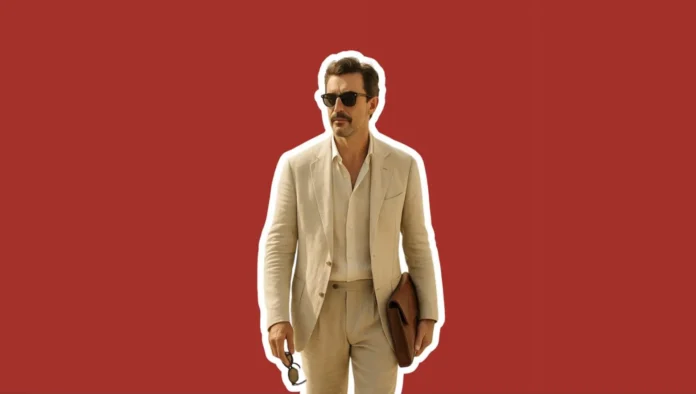
There’s a detail that immediately betrays a certain privilege: not the brand, not the logo, but the crease in linen. It’s the mark of someone who embraces elegance without the anxiety of perfection; who knows that beauty lies not in a glossy showroom appearance, but in lived imperfection. In summer, along Ligurian alleys or the little white squares of the South, the cliché is timeless: the professional on vacation—perhaps the archetypal “lawyer”—wearing a linen shirt or suit, soft loafers, moving at a leisurely pace. Fashion comes and goes; linen endures.
Linen isn’t a trend: it’s the archaeology of elegance. The oldest sewn garment we possess—the Tarkhan dress, over 5,000 years old—is made of linen: excavated in Egypt and now preserved at the Petrie Museum in London. A piece already “modern” when the pyramids were still under construction.
Why does linen prevail in summer? For physical reasons before aesthetic ones: it lets air pass, controls humidity, but being non-elastic, it wrinkles quickly. That’s not a flaw: it’s its alphabet.
The crease in linen is a moral reminder. It says: “We’re not in the office.” It says: “Today, time is ours.” It’s the opposite of stiff suits and synthetic materials that have no history. The crease, if you look closely, tells the story of the day: the scooter ride, the coffee standing up, lunch in the shade, the square by the sea at sunset. It’s a tactile chronicle.
Behind the myth lies a real supply chain. Linen is also an image. In the 1980s, Miami Vice brought onto TV the light, unstructured linen suit—with a T-shirt underneath and espadrilles: Don Johnson entered pop culture dressed in a sea-borne white that became iconic. At the end of the ’90s, The Talented Mr. Ripley sanctified a Mediterranean sartorial style: summer blazers, natural fabrics, a life in the sun. It’s an aesthetic still dictating the vacation wardrobe today.
And in the present? The “loose” linen suit returns as a sign of sophisticated nonchalance—we’ve seen it on red carpets and photocalls, worn by Brad Pitt and others. It’s not just hot-weather dressing: it’s a social language that says, “I don’t have anything to prove; I’m hot, but I have style.”
Here’s the pact: you accept a wrinkle in exchange for breathability; you give up compulsive ironing to gain naturalness; you face summer dressed like an adult, not like a tourist. And above all: linen ages gracefully. Cuts, lapels, shoulders change; the idea of an elegance that doesn’t ask for forgiveness remains.
Imagine the scene: an August morning, a seaside village. He arrives: an open-button linen shirt, sand-colored trousers, glasses that don’t chase trends. He doesn’t flaunt; he belongs to the place. The crease accompanies him. And the cliché, when it’s this true, stops being a cliché: it becomes tradition. Now, more than write about it, it’s better to step outside: leave the iron on the shelf, take in the light, and give the day the time it deserves.
— M.S.