
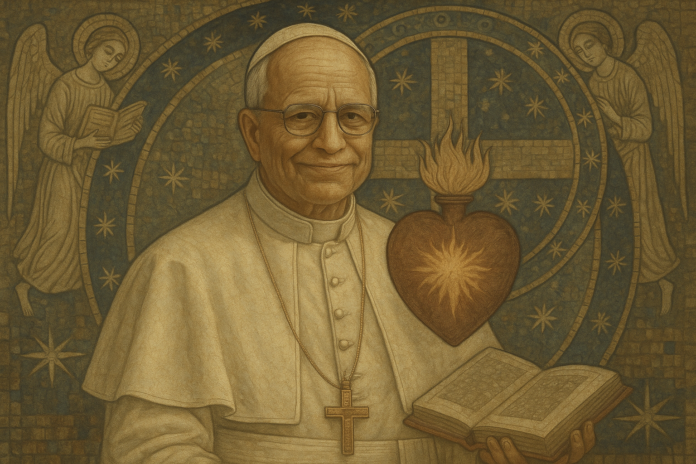
Anyone passionate about prophecies has probably asked this question: which motto could describe the pontificate of Pope Leo XIV, according to the enigmatic formulas attributed to Saint Malachy?
Already in 2014, in this very newspaper, I raised the debate in an article titled “Petrus Romanus or De Gloria Olivae?”, reflecting on the destiny of the Church in light of the mysterious Latin locutions that, according to tradition, were associated with Peter’s successors. Today, with the election of Leo XIV, that path becomes relevant once again—though with a new nuance, to be interpreted rather than dogmatized.
According to legend, Saint Malachy of Armagh drafted in the 12th century a list of 112 short mottos in Latin, each linked to a future pontiff, culminating in a mysterious figure: Petrus Romanus, destined to lead the Church through a time of extreme persecution. Immediately before appears the motto De Gloria Olivae, often—perhaps arbitrarily—connected to Benedict XVI.
The so-called Prophecies of Malachy—a list of 111 mottos plus a final one on “Peter the Roman”—are considered by the vast majority of scholars to be a pseudoepigraphal text, that is, not authentic. Historical evidence indicates that they were composed toward the end of the 16th century, not by the medieval saint to whom they are attributed. The document first appeared in 1595 in the Lignum Vitae by Benedictine monk Arnold Wion, and it is strongly suspected that Wion himself (or circles close to him) created it anew.
Many historians agree that the “prophecy” is a late sixteenth-century forgery, probably crafted during the conclave of 1590 for propagandistic purposes. The Catholic Church has never officially recognized the validity of these mottos, which do not appear in any doctrinal list or document approved by the Holy See. Nevertheless, the text has continued to fascinate for its evocative power.
A further sign of its artificial nature is the arbitrary inclusion, in Wion’s list, of ten antipopes mixed among legitimate pontiffs, without clear distinction. Such names are absent from official papal lists. If these insertions were excluded, the sequence of mottos would shift: ten pontiffs would still be missing before reaching Petrus Romanus, and many modern attributions would need to be reconsidered.
In this perspective, the motto Ignis ardens—the burning fire—emerges as a plausible spiritual description of the pontificate of Pope Leo XIV. A suggestive hypothesis, certainly, but by no means unfounded.
An Augustinian Pope: Symbols of Fire and Conversion
Pope Leo XIV is Augustinian. And the symbol of the Order of Saint Augustine is a burning heart, pierced by an arrow, resting on a book. The heart represents love for God; the flame, the desire for holiness that consumes and transforms; the arrow, the Word that pierces. A symbol that speaks of interiority, of spiritual passion, of an ardent life.
Is this not—at least symbolically—the image that best represents the new Pontiff today?
A Rereading of the Mottos: Suggestion, Not Prediction
If Ignis ardens could be referred to Leo XIV, the entire list of mottos might be reinterpreted in the light of new symbolic associations—not with the pretense of dogmatic attributions, but with the intention of exploring the spiritual and stylistic affinities between the popes and their mottos.
Pius XII could embody the image of Peregrinus Apostolicus, for his tireless diplomatic and spiritual action in dark times. John XXIII, with his conciliar openness, could recall Aquila rapax, bold in his flight toward reform. Paul VI, caught between prudence and determination, could reflect the complex symbolism of Canis et Coluber. Benedict XVI, with his historic renunciation of the pontificate, might be framed under the motto Crux de cruce, bearing both the cross of authority and that of renunciation. Pope Francis, finally, with the sun in his coat of arms and his pastoral style, fits perfectly with Lumen in coelo, the light in the sky.
And finally, Pope Leo XIV. Ignis ardens. Not by external analogy, but by inner correspondence. By spiritual essence.
A Fire That Speaks to Our Time
Ultimately, the hypothesis of Ignis ardens for Leo XIV makes no claim of absolute truth. It is one interpretation among many, but one that shows symbolic, spiritual, and, in a certain sense, ecclesial coherence.
Prophecies—whether historically grounded or not—have never had the task of dictating the news. Rather, they serve to question, to inspire reflection, to evoke. And perhaps this is precisely the role of those who, with faith and intelligence, look to the signs of the times: to let themselves be warmed, without being consumed.
M.S.
This article is a translated and adapted version. The original text in Italian is available here: Papa Leone XIV: “Ignis ardens” nelle profezie di Malachia