
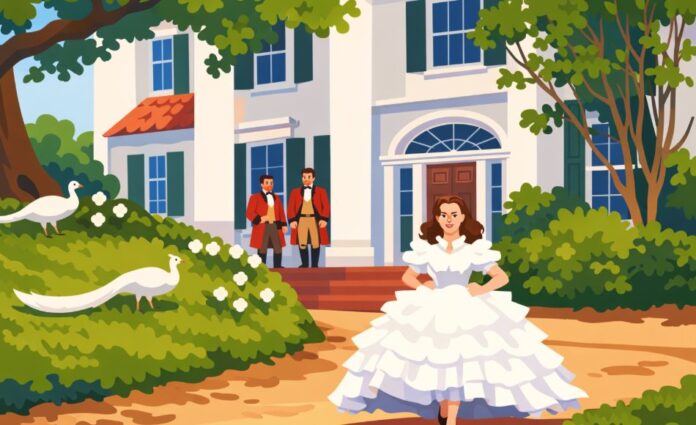
On December 15, 1939, in Atlanta, the premiere of Gone with the Wind took place. For the occasion, the main protagonists arrived, revered in their status as stars, somewhat intimidated before an audience still mindful of the events, among whom there were even elderly veterans of the War of Secession (1861/1865).
Leggi anche: Juan Carlos: The King Spain Threw Away
Leggi anche: The Davide Cervia Case
We speak of Clark Gable (1900/1960), Rhett Butler in the film, a cynical womanizer and filibusterer; in real life an iconic boy from Ohio, a Freemason, idolized by female crowds, although the venomous Kenneth Anger (author of Hollywood Babylon) recounted that it was precisely he who demanded the change of director, from George Cukor to King Vidor, since he had had a relationship with the former. Clark was accompanied by his third wife (after two older women who had launched his career), the stunning colleague Carole Lombard, symbol of the sophisticated films of the Thirties, who would leave him prematurely widowed in 1942, having perished in an airplane accident. Gable would pass away after the exertions of the film The Misfits with the capricious Marilyn, leaving a pregnant widow and another daughter born from a relationship with actress Loretta Young.
There was Vivien Leigh (1913/1967). A prestigious interpreter, already very young, of London’s Old Vic, after a marriage that had ended and a daughter, she had met the most prestigious Shakespearean interpreter of all time, Laurence Olivier (1907/1989); once free, the two married and it seems that he, already very famous also in the USA for his performances on the big screen, imposed her in the role of Scarlett O’Hara, prevailing over fierce competition, especially from Paulette Goddard, supported by her then husband Charlie Chaplin. Vivien and Laurence would remain married for several years, but she would suffer emotional fragilities that would lead her to an unhealthy lifestyle, until her death from tuberculosis.
Olivia de Havilland was not missing, who portrayed the gentle Melanie, the most long-lived, who passed away in 2020 at 104 years of age, sister/rival of her colleague Joan Fontaine.
One recalls the elegant British Jew Leslie Howard, who would meet a premature end on June 1, 1943; having completed a round of professional lectures, the airplane on which he was traveling was shot down over the Bay of Biscay by the Luftwaffe and conspiracy theories still persist. Howard interpreted the gentle Ashley Wilkes, unfulfilled love of Scarlett, husband of Melanie.
The plot is well known. Original title Gone with the Wind, it tells of a rich and spoiled girl of the southern United States (Scarlett, for us Rossella), daughter of a landowner, who lives in a mansion called “Tara” among parties and suitors; she will undergo the effects of war and economic decline, until the encounter with Rhett, the tempestuous love and the sorrowful ending, not without hope.
The inspiration came from the homonymous book, written by Margaret Mitchell (1900/1949), a bourgeois woman from Atlanta, twice married without children, also known for an interview with Rudolph Valentino, Pulitzer Prize winner and candidate for the Nobel Prize for Literature thanks to this monumental work. It seems that Mitchell had written it thinking of Clark Gable as Rhett and thus a negotiation among major film studios was triggered to succeed in hiring him. Producer David O. Selznick (1902/1995) sweated seven shirts, finally succeeding in his project.
It consists of four volumes, at least so we read it, which go into details sometimes glossed over in the film, already considered too long even after cuts. Originally Scarlett marries twice, with Melanie’s brother Charles and with Frank Kennedy, and has a child from each of them, children not present in the film.
Other characters have gone down in history, beginning with “Mammy” (a sort of governess and vice-mother, African American, of well-bred girls of that time in those places), interpreted by the corpulent Hattie McDaniel (1893/1952), Oscar as Best Supporting Actress, remembered by gossipmongers for a lesbian affair with colleague Tallulah Bankhead, after three ended marriages.
Mammy was part of the team of “house negroes” (thus in our dubbing), who led a better life than those employed in the fields; both she and the other Blacks speak with the “booming voices” attributed to Africans, so much so that Hattie was targeted by accusations of genuflection to white prejudices and even of being a spy of racist movements: accusation rejected by her outright, pointing out that, thanks to her earnings as an actress, she had avoided being a “real servant” in the houses of the rich.
Scarlett’s father, Gerald O’Hara, is Thomas Mitchell (no relation to the writer), already a well-known face at the time, seen for example in Stagecoach with John Wayne. A collateral but significant character is the prostitute with a heart of gold and brothel keeper, friend of Rhett, Belle Watling, interpreted by Ona Munson (1903/1955), who died by suicide from overdose.
The anecdotes about the difficulties of production, the relationships among the protagonists, and the whole corollary of that kind of environment, have abounded, one for all: Gable was incapable of even the most elementary dance step and a movable platform was necessary for the scene of the dance between the two with Scarlett.
The special effects of the time were employed. For example, the villa “Tara” obviously did not exist; the exterior scenes were shot in front of a large building of the Metro-Goldwyn-Mayer studios, then reworked with photographic tricks. A complex system of mannequins represented the wounded placed in the center of Atlanta, whose arms are raised with invisible wires which, upon close inspection, appear unnatural.
The film was certainly the fruit of Selznick’s visionary temperament, but it fell within a framework of construction of an epic history of the USA, until then considered, at least in Europe, the overflow outlet of adventurous and rough immigrants.
After independence was proclaimed in 1776, the great country had struggled to find cohesion; some southern states resisted the rules imposed by the northeast, and by Abraham Lincoln, considered father of the homeland together with George Washington, Thomas Jefferson and Theodore Roosevelt, whose faces are carved into the rock of Mount Rushmore, in South Dakota, starting in 1941, to celebrate the 150 years of the definitive founding of the USA, subsequent precisely to the end of the civil war dealt with in the film.
…
The final version considers the southern “Confederates” losers, commanded by General Robert Lee, and the northern Unionists winners led by General Grant.
The main divergences, it is said, concerned the economy, industrial and open to immigration in the North; agricultural, based on cotton, and more static in the South, where therefore pockets of poverty took root. It is curious that protectionism was dearer to the Northerners, to guarantee the circulation of national manufactured products, while on the other side one tended to favor free trade, coloring with transversality the modern vision of commerce and the institution of tariffs: which today seem a reactionary idea only depending on who has won the elections.
A crucial node, however, has always been considered the question of the slavery of people of color, opposed precisely by Lincoln. Vermont was the first to ban slavery, in 1777, as an independent republic. The first of the states of the Union was Pennsylvania, in 1780, with the revolution still in progress.
On February 4, 1861, in Alabama, a Confederate government was instituted under the presidency of Jefferson Davis, favorable to slavery. Some Confederates attacked a garrison in the bay of Charleston, in South Carolina. Lincoln ordered to open fire and this was the beginning. That conflict is considered the first on modern bases, with the use of warships (which the Southerners reinforced by creating ironclads) and submarines.
The fundamental and bloodiest battles, considering daily losses, were Shiloh (or Pittsburg Landing, Georgia), April 6/7, 1862, and Antietam (Maryland), September 17, 1862. In that year the North decreed a naval blockade that prevented the unloading of southern cotton, causing however problems with exports toward Europe. England, still resentful for the loss of overseas colonies, immediately turned to African producers; the Union remedied by inducing Europe not to recognize the Confederate nation, advertised as the real problem due to the obstinacy in maintaining slavery. It must also be said that African Americans of the North, free, had to go to war, with troops obviously commanded by “whites”, a fate that did not touch those on the other side: freedom also meant more cannon fodder.
Decisive was the battle of Gettysburg, Pennsylvania (July 1–3, 1863), with which the Union barred the way to troops arriving from Virginia.
After the battle of Appomattox Court House, on April 9, 1865, came the surrender of the Confederate general Robert E. Lee to the Union, with the end of the conflict, followed by a residual clash at Palmito Ranch in Texas, fought on May 12–13, 1865, after surrender had already been declared.
Thus approximately four million slaves were “emancipated”, through the Thirteenth Amendment of the Constitution, fruit of the battles of Lincoln’s Republican Party. The latter, assassinated on April 15, 1865, had been protagonist of yet another great turning point of the country, made possible thanks to the Homestead Act (1862), which assigned plots of land to anyone who had worked the land for at least five years.
It may seem bizarre, but Kentucky ratified the Thirteenth in 1976, Mississippi in 1995: theoretically, until those years, in those states slavery was still legal.
Abraham Lincoln died assassinated on April 15, 1865, officially by the hand of John Wilkes Booth, an actor sympathetic to the southern cause, within a conspiracy. It is not clear why conspiracy theories are endorsed when they concern ancient facts and derided when they are more recent. Or perhaps it is. Lewis Powell, of the band of killers, was supposed to kill the Secretary of State, William Seward, but only managed to wound him and some relatives. The trial put all the “conspirators” under accusation, even only for aiding and abetting.
Obviously the death penalty was imposed, with the execution of Mary Surratt, Lewis Powell, David Herold and George Atzerodt on July 7, 1865, at Fort McNair in Washington; O’Laughlen died in prison of yellow fever in 1867. Mudd, Arnold and Spangler were pardoned in February 1869 by President Johnson.
Strange is the fate of John Surratt, who fled, arrived fortuitously in the Vatican, where he was arrested, but managed again to escape, until arrest in Egypt. The trial failed to clarify his responsibilities; he died free in 1916.
The question of slavery is complicated. According to some theories, slaves, already since the Middle Ages, constituted a cost; they had to be “imported”, kept alive, supervised; the raider and the “overseer” of this labor force did not earn enough and often preferred to dedicate themselves to raids. In periods of absence of protection of workers, the practice fell into disuse, in favor of temporary hiring and dismissals not contestable if the employee was no longer able to work, leaving him to his fate, almost up to our days (also in Italy, one thinks of gang-mastering): this aspect of “deregulation” would have facilitated liberation movements.
The northern colonies were founded as religious refuges, with economies based on small farms, thus they did not need a large number of slaves. The southern colonies were founded as agricultural export operations, on the same line as the sugar plantations of the Caribbean. Beginning with tobacco as the main commercial crop, they needed much manpower, due to the prevalence of large estates.
Still according to theories, the North had the advantage of a low-cost labor force for the constant inflow of immigrants, as opposed to a much less populated South, also because climatic conditions, the spread of malaria and scarce industrialization did not encourage immigration; and after all the world needed cotton and the system, up to a certain point, suited everyone. Many of the southern states would have aligned with England if the Founding Fathers had insisted on the abolition of slavery; the North became more resolute in abolishing it when the English danger and the phenomenon of loyalism had ceased. The northern states also benefited from the practice of slavery in the South. Cotton exports passed through New York, which taxed heavily, aware that the South could produce much more cotton using slaves; the same held true for production in New England, which sold to the South equipment to be used in plantations.
From West Africa the flow of departures was not always forced, or at least is comparable to today’s great exoduses, in which many diasporas are favored by organizations that present a West certainly more attractive than the land of origin: the slogan “let’s help them at home” no longer seems fashionable. When it became evident that the North offered more jobs, in any case more circulation of money, legal or not, and freedom, many Blacks moved there. In Latin America the last to abolish slavery were Cuba (1886) and Brazil (1888).
Another line of thought would seek to explain such phenomena. The English would have fomented racial separatism to keep the nascent overseas state divided; they sided with the Confederation in the civil war, constituting almost an subversive enclave for the return to the British motherland. According to such orientation it would be wrong to speak of “war of secession”, rather it having been a war for dominance.
…
The theme runs through the entire film, and also constitutes the only moment of friction between Scarlett and the man she aspired to, Ashley the mild, who claimed humane treatment toward slaves, who would in any case be freed shortly thereafter. As for the fact that Gone with the Wind is a racist film, which has led to its removal from HBO-MAX catalogs, this appears a controversial circumstance. Rhett Butler affirms that Mammy is one of the few people whose esteem he holds; the woman has great influence over the daughters, in particular over Scarlett, and keeps her sheltered from the consequences of her disinvolute opportunism, which escape even her own mother, a devout lady devoted to works of charity; and the most odious characters are the overseer and his concubine, Irish, who will immediately take advantage of the ruin of Tara to appropriate the lands.
Perhaps the most fitting discourse comes precisely from Ashley. A pacifist inclined toward philosophy, he affirms: “If the South fights, I am for the South, but our world is destined to disappear.” Wilkes will then go to war and return safe and sound. Only then will Scarlett understand that she no longer loves him, perhaps that she never loved him, but that she had cultivated a maniacal passion, at the expense of her marriage with Rhett; who, for his part, will reiterate to her that both are corsairs of life and made for one another; but, after the death by horse of their beloved daughter Bonnie, he will decide to return to his raids, while she concludes with the famous closing line: “After all, tomorrow is another day.”
That conflict established an arrangement destined to contaminate the entire globe. Today the States appear once again unbalanced and the great progressive metropolises attract no one anymore. Who knows how it will end.

