
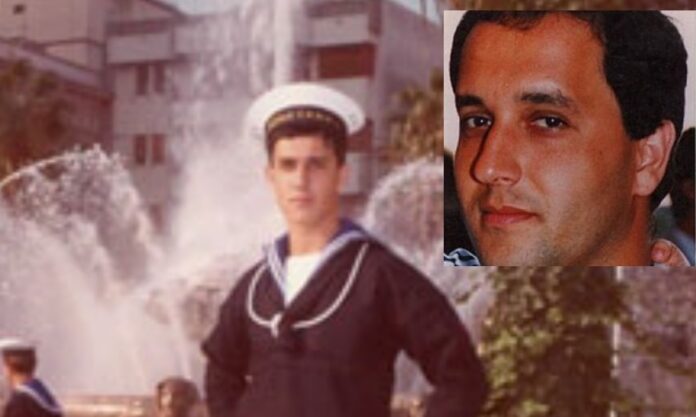
For the sake of sensitivity, we wish that Davide Cervia had been spoken about even half as much as other famous cases of disappearance, but we know how the world works—indeed, how Italy works: although, given the outcome of media distortions, perhaps little would have been achieved anyway.
Leggi anche: Juan Carlos: The King Spain Threw Away
Sources are extremely few. The same document “nr. Legislatura 17 Atto di Sindacato Ispettivo n° 2-00275 – Atto n. 2-00275 (abbreviated procedure), published on May 14, 2015, in session no. 451”, from which we draw information, mainly cites interviews and websites, including some of conspiratorial nature. We have no acts, minutes, or other corroborating documents.
Davide Cervia was born in 1959 in Sanremo to a Piedmontese family from Borgomanero. He graduated as an electronics technician and immediately enlisted in the Navy, attending the Mariscuola in Taranto for non-commissioned officers; he was then sent to Rome for specialization, and later stationed as a sergeant in La Spezia, serving aboard the ship Maestrale, from which he could be dispatched on missions at sea.
However, upon returning from a family visit, he met Marisa Gentile on the train and gave up his military career, which nevertheless had appealed to him. As soon as possible, he left the service, married her in 1982, and for a while the two stayed in La Spezia before moving to Velletri, where her father had provided land on which to build a house. Davide found employment at Enertecnel Sud in Ariccia, a factory producing electronic components, where he became head of department, while their children Erika and Daniele were born. We have no information about Marisa’s occupation, so we may assume she was a homemaker caring for the still-young children, aged six and four.
Their home, rather isolated, was on Via Colle dei Marmi, reached by a small road branching off the main one. Usually, Davide left work at 5 p.m., and on that September 12, 1990, he was expected home as usual, to play with the children before dinner. His colleagues later reported that he had been particularly eager to return home that day, wanting to help his little daughter practice riding her bike. The wait was in vain—he never came back. On the 13th and 14th there were silent phone calls, followed by another about fifteen days later.
After the missing person report was filed, months passed without news. During that time, Marisa recalled some earlier odd episodes: a hole in the fence, the car catching fire from a short circuit—which had made Davide cry—his purchase of a rifle, saying it was to keep wild animals away, and strange cars driving around nearby.
On December 2, 1990, the caretaker of the nearest villa, seventy-year-old Mario Cavagnero, who lived alone most of the year, came forward. He claimed that afternoon—around the time Davide would have been returning home—he had seen Davide’s white Golf stopped in front of the gate, blocked by another car of the same model, dark green. Several men had seized him, apparently drugged him, and transferred him into the second car, while one of them drove off in the white Golf. Davide had shouted his name—Mario—three times.
Some time later, an Acotral bus driver, Alfio Greco, also came forward. He said that at the junction between the small road and the main one, he had to brake suddenly because two Golfs, one white and one green, had cut him off at high speed, ignoring the right of way. He ruled out that the driver of the first car resembled Davide; in the other, he glimpsed two figures sitting in the back, their arms positioned as if to hide a third person between them—not bad, considering the glimpse lasted barely a couple of seconds.
After confirming there were no accident reports or hospital admissions, Marisa began phoning all over the world, including her husband’s former Navy colleagues, from whom she learned about aspects of his professional past that she had not known. Thus it emerged that Cervia had attended highly sophisticated and selective courses in warfare systems, and had obtained NATO security clearance (NOS), which expired in 1986 after his resignation (and with it, according to relatives, the institutional protection he once enjoyed).
A former colleague proposed what would become the dominant theory: that Davide’s disappearance was connected to his technical skills, referring to a 1980 course that certified him as an expert in electronic warfare with the code ETE/GE. Years later, Marisa claimed to have found a paper with those notations in a drawer. On August 2, 1990, the U.S. invasion of Kuwait had taken place; at the beginning of 1991, embargoes were imposed on several Arab states, and many European technicians were recalled, forbidden to provide technical assistance. Thus grew the hypothesis of an abduction by agents from Gulf countries—or Libya, as always—to employ a highly specialized technician capable of repairing their weapon systems. But why Cervia, and why only him?
In fact, the Navy’s SIOS (Information, Operations, and Situation Service) immediately began investigating, though it was slow in communicating with the judiciary. In October, more anonymous calls arrived, with prerecorded voices speaking strange, possibly Middle Eastern, languages.
The case received attention from the TV program “Chi l’ha visto?”, then hosted by Donatella Raffai. In February 1991, an anonymous caller—claiming to be a former colleague of Davide with the same qualifications—reported having been pressured to collaborate with foreign defense agencies and threatened after refusing. A Capuchin friar from Velletri came forward with further anonymous testimony from the wife of another former officer, who told of similar events and of living in fear to escape “dark forces.”
On the desk of that television studio—by means unknown—an anonymous letter was later found, never mailed but clearly placed there by some unseen hand. The show would later experience another mysterious event: in 2005, it received an anonymous call about the Emanuela Orlandi case, indicating the tomb of Renato De Pedis, yet phone records never showed any incoming call.
The mysterious letter led to the discovery of Davide’s Golf, parked on Via Marsala beside Termini Station. It was a bit dusty, but the stereo—with equalizer—was still there, which was unusual in that area, where such items were typically stolen within minutes. Inside was a bouquet of now-dried roses, which Davide reportedly often brought to his wife.
Let us outline the main complaints and actions taken by the family—mainly Marisa and her father, later the grown children—along with our own remarks, as we have no news of Davide’s relatives.
It seems the Carabinieri delayed circulating Davide’s photo and the license plate of his Golf. This would be regrettable, though as we have seen, Raffai’s program made up for it. Marisa said she was embittered by suggestions of voluntary disappearance—a common pattern: families hold their loved ones in their hearts, but law enforcement and the public do not know them, so this is always one of the first hypotheses. Davide had been preparing plans for installing an external meter, had chosen new furniture with his wife, ordered fresh eggs for the children, and was organizing their wedding anniversary party—not the behavior of someone planning to flee.
It is lamented that caretaker Mario was discredited as too old and farsighted to have seen clearly—but why did he wait so long to speak? He justified himself by fear and by hoping to be sought out, not wishing to expose himself first. We rather wonder how he happened to witness the scene at that precise moment; why he heard the cries while the family did not; and why Davide would have shouted his name rather than his wife’s. Above all, we ask: if secret agents or foreign emissaries wanted to kidnap Davide, why do it right at his home gate, instead of along the route through the countryside? Such operations are usually carefully planned.
Hence doubts also about the bus driver’s account, which no passenger confirmed. Would the kidnappers really have risked a head-on collision?
In such cases, one suspects—benevolently, as similar cases suggest—that some wish to “console” the family, easing their despair with stories offering false hope.
As for the flowers found in the car, that may or may not mean anything. Someone familiar with Davide’s habits might have placed them there—but that’s irrelevant. More interesting would be to know where the car had been until then, since witnesses said it had not been seen there in the preceding days or months. The intact stereo and equalizer, brand new, suggest it had been parked there not long before being found.
When the Navy was asked for his service record, it issued one listing Davide merely as an electrical technician. After prolonged efforts, on September 14, 1994, the family finally obtained his professional profile confirming that he had specialized in electronic warfare and completed “courses of particularly specialized content.” A classmate later said that only six men held that qualification, and their expertise exceeded that of engineers. An instructor added that Davide knew the weapon systems used on Italian warships, such as the Teseo Otomat, sold in a thousand units to Iraq and Libya.
According to Marisa’s father, Alberto: “There was proof that an Air France ticket for the Paris–Cairo route, in January 1991, was issued in the name of Davide Cervia. That ticket had been issued on behalf of the French Ministry of Foreign Affairs”—a claim later denied by Air France. Alberto insisted: “In a SISMI report we have, it says: It is possible that the disappearance of Davide Cervia is linked to a kidnapping by international organizations such as Libya, Iraq, or Israel, with the complicity of Italian agencies. The motive would be Cervia’s specialization in GE electronic warfare and his skills, indispensable at that time to those countries on the eve of the Gulf War, as an expert in the maintenance of electronic systems and weapons sold by Italy to said nations.” (Cronaca-nera, April 8, 2013)
Despite interest from the Prodi government and promises from dubious characters claiming that Davide was in Romania with Iranians, the appointed “liberation day” in 1997 came and went without event. According to the family, the following years were full of anguish—offers of money to remain silent, more anonymous calls, a strange explosion in the house, appeals to the authorities. In 2000, Davide was declared legally dead.
On January 23, 2018, the Ministry of Defense was convicted for violation of the right to truth. The Cervia family had requested a symbolic compensation of one euro, and the minister at the time, Five Star member Elisabetta Trenta, waived the appeal, acknowledging state responsibility for the cover-ups.
In more recent years, a controversial episode occurred. A magistrate linked the discovery of a body in Lake Maggiore in 2013 and requested DNA from Davide’s sister, inserting it into the national database. The match seemed strong, but Marisa rejected the idea: in her view, after the 2018 ruling, the State—feeling guilty—was merely trying to prove Davide’s death. Yet the body from the lake was 1.68 m tall, while Cervia was 1.82 m; his children refused to provide samples (Canale 122 Fatti di Nera, September 19, 2022). We may only note, incidentally, that Lake Maggiore lies near Borgomanero, the Cervia family’s hometown.
It is evident that the theories advanced are decidedly conspiratorial, whether one likes it or not. Some adore conspiracy theories, some despise and mock them, others use them selectively. We, fond of stubborn coherence, would like to know whether those who claim a kidnapping aided by military leadership belong to the first or second category; the third, to us, seems opportunistic.
As for the insinuation that the Italian State “sold” one of its experts, Salvo Andò—Minister of Defense in 1992–1993 under the Amato government—observed that a valuable resource like Davide would be protected, not surrendered, even if no longer in the military: civilians also work in national defense sectors.
Magistrate Luciano Infelisi, who handled the case, agreed on the hypothesis of a kidnapping to exploit Cervia’s technical know-how, offering two possibilities: either the man remained working for some foreign power, unable to return home; or some mishap occurred—perhaps he was eliminated to keep him silent, or he died of other causes.
In Italy, hostility toward the military is old, partly fueled by certain political factions. The category bears the weight of accusations that even acquittals cannot erase. The public has been conditioned to believe that favorable verdicts stem from corruption, while condemnations are almost always applauded.
The country has always been politically unstable, with short-lived governments and legislatures ending prematurely. The defense minister of the day cannot be held responsible for events that happened decades earlier. The 2018 ruling established that the Cervia family’s right to truth and justice was gravely violated—but how often does that happen in silence and indifference? Could the Cervia case be considered a precedent for all similar failures of transparency and citizens’ rights, past and present?
Davide inevitably recalls Ettore Majorana—a “beautiful mind,” perhaps aware of too much, a keeper of secrets he never revealed.

